Checkers strategy: openings and tactics
What decides a checkers game beyond the rules: the centre, the back row, forced captures and looking two moves ahead. Tactics, opening principles and a way to train on eighty puzzles.

Short answer: checkers is decided by three habits. See every forced capture, yours and your opponent's. Hold the centre and the back row. Calculate the reply before you let go of the piece. Almost every tactic in the game grows out of the forced capture: if an enemy piece is next to yours, neither player chooses whether to jump. That turns a sacrifice into a forcing move and makes calculation the main skill.
Start with one drill: before every move, list all the captures you have and all the captures your opponent would get after your move. Then come the opening principles and the patterns that grow from the same rule. You can play and practise in online checkers; nothing to install.
Why captures run the game
In Russian checkers jumping is compulsory, but you may choose any capture. In international and Brazilian checkers the rule is different: if several captures are available, you must take the one that removes the most pieces. That single difference changes the calculation, so this guide assumes Russian checkers unless stated otherwise.
Forced capture gives you something rare: you know your opponent's move in advance. Offer a piece, and they must take it. You can count where their piece lands and what opens next. Sacrifices, breakthroughs, pins and king hunts all rest on this. Without it, the patterns become pretty ideas that do not work in a real game.
The second consequence: there are almost no empty moves. Every move prepares a capture, prevents one, or changes the number of pieces. If you cannot explain why a piece stands on a square, there was probably a better move.
The opening: principles, not memorised lines
Openings have names, but a beginner is better served by understanding why a piece goes to the centre and why the back row matters more than a flashy attack. Names come with experience; principles work in every game.
Take the centre. White's first move is with a central man: c3-d4 or e3-d4. The man lands on d4, where it covers both central diagonals and makes it harder for the opponent to develop freely. Black answers d6-e5 or f6-e5, so as not to give up the centre for nothing. The fight then returns to the same squares: the side that gives way usually gives up the initiative too.
Do not hand over the centre. If the opponent pushes your man off d4, a trade may be good. But do not give up the square for free: from there your pieces control both directions, and the opponent has to respect the threat.
Develop, but do not strip the back row. The men on your first row guard the promotion squares and can become kings themselves. If you send all of them forward, the opponent gets a road to the last row. Keep at least one piece back until the endgame.
Trade with a reason. Every trade changes the piece count and the tempo. Trade when you gain the centre, a path to promotion, or remove an active enemy piece. Do not trade just because a capture is available.
Watch for pins. A piece that guards another piece or a promotion square is pinned: move it, and you get hit. Look for such pieces in the opponent's camp, and avoid creating them in yours without a reason.
Tactical patterns
The fork (double attack)
One of your pieces threatens captures on two enemy pieces on different diagonals. The opponent can move only one of them, so the other stays under threat. If they have a compulsory capture elsewhere, they may be forced to take it, and the fork works even better. Look for a square from which your piece attacks two targets at once, especially when the enemy pieces sit on neighbouring diagonals.
The sacrifice for a path
You put a piece under capture on the road to the last row. The opponent must take it, their piece leaves the diagonal, and your second piece goes through. Count to the end: after the sacrifice the opponent may have a reply capture that breaks the path. The sacrifice works only when the reply is forced.
The breakthrough
Several of your pieces go for the last row, often with one of them sacrificed. The position has a marker: the opponent has too few pieces on the needed diagonal, and you have a chain that can go through. Count the breakthrough to the new king, not to the first step. The new king must not be caught immediately.
The pin
A piece is pinned if moving it opens a capture on another piece or on a promotion square. You attack what it guards, and the opponent cannot move the guard without losing something. The pin is strongest when the guarded piece stands on the road to the last row.
The cutoff
Cut part of the enemy pieces off from the centre or from each other, then take them one by one. Do not chase every piece: limit its mobility, and it will fall under a capture by itself. Often one well-placed piece is enough to block the support the opponent was counting on.
Hunting a king
A king is strong, but it can be caught. Drive it to the edge, cover the diagonals with your pieces and give it no room to turn. In Russian checkers the king is long-range, so the hunt needs exact calculation. In English checkers a king moves one square at a time, and catching it is much easier.
Opposition in the endgame
When only kings are left, opposition often decides the game. Two kings on the same diagonal, with several empty squares between them. The side to move often has to leave the diagonal, and the opponent takes its place. Count the squares between the kings and whose turn it is; this is not something you can judge by eye.
How to solve the puzzles
The game has eighty puzzles that ask for the winning move. They differ by rule set, difficulty and solution length, and that makes them useful for training.
| Rule set | Puzzles |
|---|---|
| Russian | 28 |
| English | 14 |
| Brazilian | 14 |
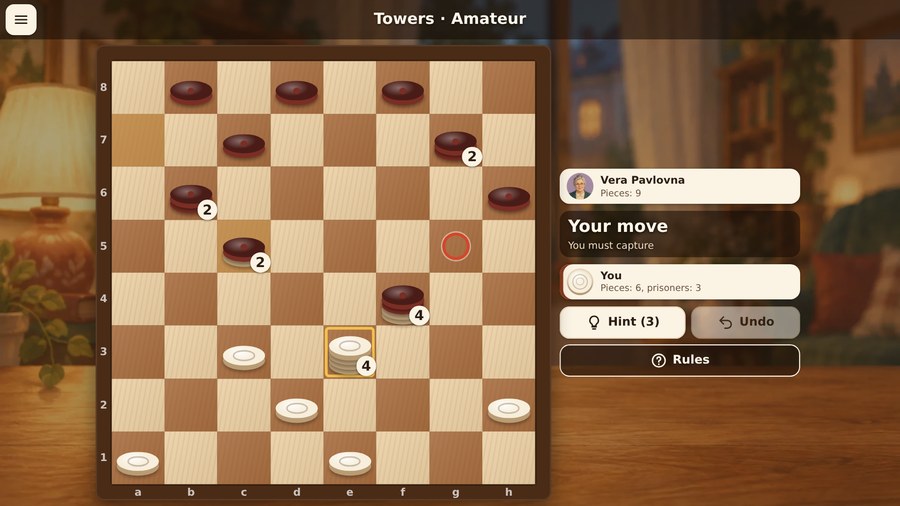
| Towers | 14 |
| International | 10 |
By difficulty there are 29 easy, 12 medium and 39 hard. By solution length, 30 puzzles are solved in one move, 42 in two and 8 in three.
Start with the easy and one-move puzzles: there are 29 and 30, and they partly overlap. The goal is not to guess the move but to see every capture at once. Then move to the two-move puzzles: here the first move must be forcing, usually a sacrifice or a capture, so the opponent has no choice. Leave the eight three-move puzzles and the hard ones for later: they require counting to the end, including the opponent's replies.
A useful order for each puzzle:
- List every capture you have, even the ones that look bad.
- For each capture, check what captures the opponent gets in reply.
- Look for a move that makes the reply compulsory: then the line can be counted to the end.
- Check the last row and the kings: often the win comes from a promotion, not from a capture.
After a game, use the review: the computer marks the best move, an inaccuracy and a blunder. That is faster than finding the mistake yourself, especially in a long game.
Common mistakes
- Calculating only your own move. In checkers the reply is often forced, so one move without the reply means nothing.
- Forgetting a compulsory capture. Yours and the opponent's. If they have a capture, they may be forced to take it, and that changes your plan.
- Trading a king for two men without counting. Sometimes it is good, but a king is usually stronger than two men, especially in the endgame.
- Leaving the back row. One piece sent forward can open the road to promotion.
- Chasing material. A capture that takes your piece out of the game can cost the game.
- Playing pretty instead of forcing. A pattern works only when the reply is compulsory. Otherwise it is hope, not tactics.
- Not counting pieces in a trade. Before a series of trades, count who will have more material and whose turn comes next.
Where tactics stop working
Tactics do not replace calculation. Checkers hides very little: the compulsory captures are visible on the board, so intuition without counting runs into a strong player quickly.
In giveaway checkers the goal is reversed: the first player to give away all their pieces wins. Sacrifices and captures change meaning, and the usual patterns do not transfer. Towers has its own rules about prisoners and stack height. In international and Brazilian checkers the majority rule takes away your choice of capture, and in English checkers the king moves one square, so hunting it is much easier.
If you play only Russian checkers, puzzles on other rule sets are still useful: they train vision and counting, but do not copy their solutions one for one.
FAQ
Where should a beginner start with checkers tactics? With the compulsory capture. Before every move, list your captures and the opponent's replies. This one drill removes most blunders.
What is the best first move in checkers? For White, a central man to d4: c3-d4 or e3-d4. In English checkers Dark moves first, so the advice has to be recalculated for the other side.
How do I stop blundering? Check the opponent's reply, especially compulsory captures, and watch the last row. If your move leaves the opponent only one legal reply, count the line to the end.
Do puzzles help? Yes, if you solve them regularly and review mistakes. The game has eighty puzzles; start with the easy and one-move ones.
How do Russian and international checkers differ? International checkers uses a 10x10 board, 20 pieces, the majority rule, and a man does not become a king in the middle of a capture. More in checkers variants.
How long does it take to learn? The basic principles take an evening; confident play comes with practice and reviewed games. There is no universal timeline: it depends on how many games you play and review.
If the rules are still fuzzy, start with checkers rules: the board, the move, the compulsory capture and the king are explained step by step. Then practise in online checkers: eighty puzzles, a ten-lesson school and a game review. For two players, see our collection of two player games.