Checkers rules: how to move, jump and win
The standard 8x8 game in five minutes: setup, how a piece and a king move, why jumping is forced, and how a game ends. Then what changes in Russian checkers.
Checkers (called draughts in the UK) is played on an 8x8 board, on the dark squares only. Each player has 12 pieces. Dark moves first. A normal piece, called a man, moves one square diagonally forward. If an enemy piece is next to yours and the square right behind it is empty, you must jump over it and remove it. A man that reaches the far row becomes a king. You win by capturing all the opposing pieces or leaving your opponent with no legal move.
That is the whole game in a paragraph. The rest of this page covers each rule step by step, the places where beginners slip, and the differences you will meet if you play the Russian version, which is the one our online checkers game opens with.
The board and the setup
The board has 64 squares, but only the 32 dark ones are ever used. Place it so that each player has a dark square in the near left corner. Each side puts 12 pieces on the dark squares of the three rows closest to them. The two middle rows start empty.
Players take turns, one move each. Passing is not allowed. In the English game dark goes first, and our game follows that when you pick English rules.
How a man moves
A man moves one square diagonally forward onto an empty dark square. It cannot move sideways or backward, and it cannot land on an occupied square.
How to jump (capture)
If an enemy piece sits diagonally next to your man and the square directly behind it is empty, your man jumps over it, lands there, and the enemy piece is removed. Three points decide most games:
- Jumping is compulsory. If you have a capture, you must make it. You cannot make a quiet move instead. Players use this on purpose: give up one piece so that your opponent has to jump and lands in a trap.
- A man jumps forward only in the English game. Moving backward is never possible for a man, with or without a capture.
- Multiple jumps in one turn. If after a jump the same piece can jump again from where it landed, it must keep going. The whole chain is one move.
If you have more than one capture available, you may choose any of them. You do not have to take the longest chain. The only exception is that once you start a chain you must finish it.
Old house rule you may hear about: "huffing", where a player who missed a capture lost a piece. It is not part of the standard rules, and a missed capture is simply an illegal move.
Kings
When a man reaches the farthest row it is crowned: another piece is placed on top of it. In the English game a king moves and jumps one square at a time, but in any diagonal direction, forward or backward.
One rule catches many new players out. If a man reaches the king row in the middle of a jump, it is crowned and the turn ends there, even if a further jump would be possible. The new king can use it on the next turn.
How to win
You win if your opponent:
- has no pieces left, or
- cannot make a legal move, because every piece is blocked and nothing can be captured.
Blocking works as well as capturing, so a player with more pieces can still lose.
When it is a draw
A game is drawn when both players agree, when the same position comes up three times, or when long play goes on with no progress. In our game the draw also comes after 15 moves each with only kings moving and no captures. Tournaments add their own move-count rules, which you do not need for a friendly game.
Russian checkers: what is different
Our game is built around Russian checkers, so if you play it online the first thing you notice is that the pieces behave differently. Most of the changes make the game more open and tactical.
| English (American) | Russian | International | |
|---|---|---|---|
| Board | 8x8 | 8x8 | 10x10 |
| Who moves first | dark | white | white |
| Man can capture backward | no | yes | yes |
| King | one square | any distance ("flying king") | any distance |
| Must take the most pieces | no | no | yes |
| Man reaches king row mid-jump | crowned, turn ends | crowned, keeps jumping as a king | not crowned unless the move ends there |
In Russian checkers also:
- A man captures backward as well as forward, though it still moves only forward.
- A king moves any number of squares along a diagonal and captures from a distance. It lands on any empty square behind the captured piece, and if some landing squares allow another capture, it must pick one of them.
- Captured pieces are removed only after the whole move is complete (the "Turkish strike"). Until then they stay on the board and block the way, and no piece may be jumped twice in one move.
- You may choose any capture, not necessarily the largest one.
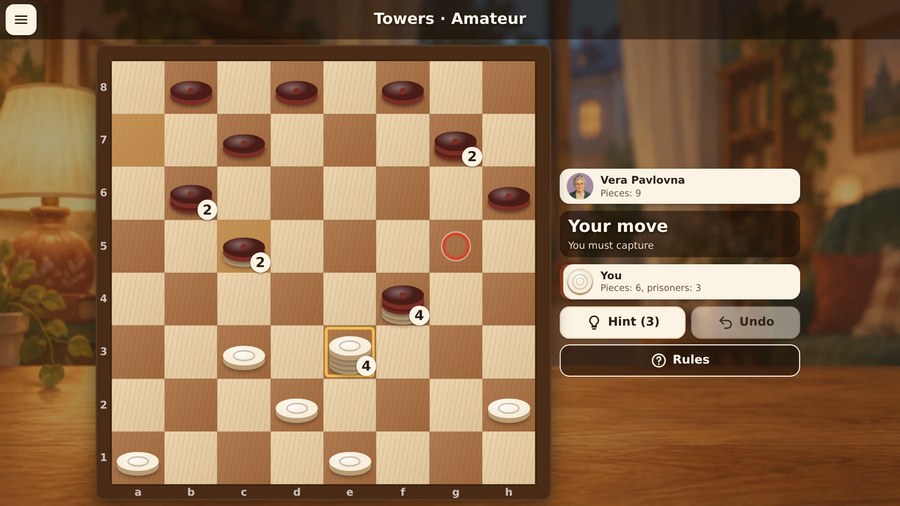
Brazilian and Canadian checkers are other relatives, and our game also has giveaway checkers, where the goal is reversed and you win by losing all your pieces, and Towers, an old variant where captured pieces go under the capturing one. If you know one set of rules, you can pick another rule set in the game and see the difference on the same board.
Common beginner mistakes
- Missing a forced jump. If a capture exists, you have to take it. In our game, pieces that can capture are outlined.
- Trying to move a man backward. It never moves back. In Russian checkers it can only capture back.
- Stopping halfway through a chain. If more jumps are available, you must continue.
- Ignoring what your own trap costs. Giving up a piece forces your opponent to jump, but check where the jumping piece ends up and what it then lets you take.
- Rushing the king. Crowning matters, but a lone king running ahead can be cut off and blocked.
Where to start
Play your first few games against a computer on the easy level: it makes mistakes, and you get used to forced jumps without pressure. Our game has a school of ten lessons, eighty puzzles where you find the winning move, and a review after each game that marks your best move, inaccuracies and blunders. You can also play against a friend on one screen, with a room code, or by searching for an opponent who plays the same rules. More games for two players are collected in games for two.
Nothing needs to be installed: checkers runs in your browser on a phone, tablet or computer.
Quick answers
Who goes first in checkers? Dark goes first in the English game. White goes first in Russian and international checkers.
Can you move backward? Not with a man in the English game. A king can move and jump in any diagonal direction.
Do you have to jump? Yes. If any capture is available you must make one, but you can pick which.
How many pieces does each player have? Twelve in English and Russian checkers, twenty in international checkers.
How do you get a king? Move a man to the farthest row. In the English game the turn ends there, even in the middle of a jump.