How to win at tic tac toe
Classic 3 by 3 is a draw with perfect play, so every win comes from a mistake. Here is how to make fewer of your own, spot a fork before it lands and play the other eight modes.

The honest answer first: classic 3 by 3 tic tac toe is a draw when both players know what they are doing. X cannot force a win, O cannot force one either, and a perfect game ends with a full board. Every win comes from a mistake, so the skill is making fewer and spotting the opponent's.
Below: the geometry of the board, the three openings, the defensive rules for O, a fork on a real seven-move game, and a plan for each of the other eight modes.
Eight lines, three kinds of squares
A 3 by 3 board has eight winning lines: three rows, three columns and two diagonals. A square is worth more when it sits on more lines.
| Square | Lines | Why |
|---|---|---|
| Centre | 4 | Middle row, middle column, both diagonals |
| Corner | 3 | Row, column, one diagonal |
| Edge | 2 | A row or a column, never a diagonal |
That gives the hierarchy: centre over corner, corner over edge. The centre offers the most ways to create a threat; an edge almost never produces a fork.
Opening moves: centre, corner or edge
All three openings draw if the opponent answers perfectly. What changes is how many correct answers you leave them.
Centre. The most flexible first move. If O takes an edge, X can force a win. If O takes a corner, the game can still draw.
Corner. The best practical opening. It leaves O exactly one reply that does not lose: the centre. Any other reply, corner or edge, gives X a win.
Edge. The weakest. O has several replies that hold the draw, and X gets almost no advantage.
If you want to beat a human, start in the centre or a corner. An edge gives the opponent too many comfortable answers.
Playing second: how not to lose
The second player's goal is smaller: not to win, but not to lose. Against perfect play that is all O can do. Against a human, X blunders often, and those blunders are where O finds wins.
Three replies cover almost everything:
- X opens in the centre: take a corner. The four corners are the only replies that do not lose.
- X opens in a corner: take the centre. That is the only reply that does not lose.
- X opens on an edge: take the centre. Then block every threat.
After that, the game is about one thing: do not hand X a fork. A fork is a move that creates two threats at once. You block one, and the other wins.
Forks: how a draw turns into a win
A fork is the only reliable way to win a game that should be drawn. Make a move that threatens to complete two lines. Your opponent blocks one, and you finish the other.
There is a pattern worth memorising. If you have the centre and one corner, look for a corner that shares a row or column with your corner and a diagonal with the centre. In the game below, that square is the top-right corner.
A seven-move game, step by step
X is crosses, O is noughts, moves are numbered.
- X takes the centre.
- O takes the top-left corner. This is the correct reply.
- X takes the bottom-right corner, opposite O's corner.
- O takes the top edge. This is the mistake: after the opposite corner, O must take one of the two remaining corners, not an edge.
- X takes the top-right corner. This is the fork: X now threatens the right column and the diagonal through the centre.
- O takes the bottom-left corner and blocks the diagonal.
- X takes the right edge and completes three in a row.
| 1 | 2 | 3 | |
|---|---|---|---|
| 1 | O2 | O4 | X5 |
| 2 | X1 | X7 | |
| 3 | O6 | X3 |
Why did O lose? After move 3, X had a corner and the centre, while O had only one corner. O needed one of the two remaining corners. The edge on move 4 did not stop X from taking a corner, and that corner gave X two threats at once.
Two rules to keep. If the opponent has the centre and a corner and you have one corner, take another corner, not an edge. If you have the centre and a corner, look for a corner that shares a line with your corner and a diagonal with the centre: that move often creates a fork.
The other eight modes
Our game has nine modes. Classic is only the first, and each relative has its own trick.
Vanishing. Each side keeps at most three marks, and the fourth erases the oldest. The next mark to disappear is drawn faded. Use it to free a square for a new threat, and do not let it break a line you still need.
Five in a Row. An 11 by 11 board, five in a line. An open three, with both ends free, becomes an open four, which cannot be blocked with one move. Closed threes that run into an edge or an enemy mark are usually wasted.
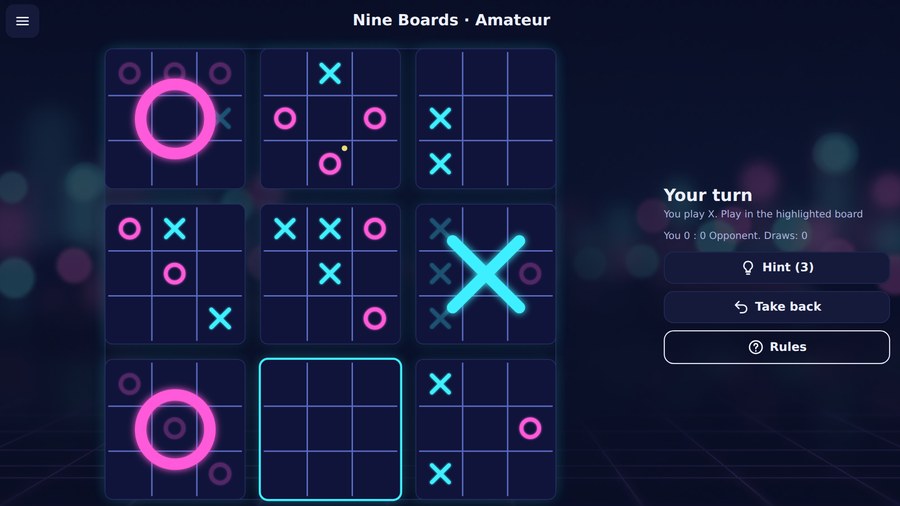
Nine Boards. A big board of nine small ones. The square you take sends your opponent to that small board; if it is already won or full, they get a free move anywhere. Take the centre board, and send them where they have no good move.
Misère. The first player to complete three of their own marks in a row loses. You force the opponent into a position where every move completes one of theirs. The centre is dangerous: four lines mean more chances to complete one by accident. If the board fills with no line, it is a draw.
Wild. On every move you choose X or O, and you win if your move completes three identical marks, whoever placed the other two. With perfect play, the first player wins only by opening in the centre with either mark; any other opening draws.
Order and Chaos. A 6 by 6 board where both place either mark. Order tries to get five in a row, Chaos blocks until the board fills. In this edition Order wins with precise play, so Chaos needs mistakes; Order builds open fours, Chaos only has to prevent five.
Notakto. Three 3 by 3 boards and one shared mark, X. Three in a row kill a board, and whoever kills the last live board loses. Count the boards alive: killing one early is not always bad, but the last kill always loses.
Cube Slide. A 5 by 5 board of cubes. Take an edge cube, mark it, and push it in from either end of its row or column; the others shift. Five in a line win, but your push can complete the opponent's line, and then they win even if you completed yours. Check both sides.
How to practise
Three computer levels: the beginner makes mistakes, the amateur sees threats, the master plays for real. In classic the master never loses; the best you can do is a draw. The beginner and amateur are where you train forks.
The practice game explains the rules in a couple of minutes. The best-move hint works against the computer and on one screen, but not online. Online games give you thirty seconds per move, so long calculations do not work.
To play a friend, open a room: the game shows a code, a link and a QR code. They join from their own browser. You can also play on one screen and pass the mouse or phone.
Where you cannot win
In classic, perfect play means a draw. That is the nature of the game: X can only avoid losing, and so can O. A win appears only where someone leaves the book.
Misère is also a draw with perfect play. Notakto has no draws: every game ends, and the player who kills the last board loses. In Wild, a centre opening wins with perfect play, any other opening draws. In Order and Chaos, Order wins with precise play.
The practical conclusion: do not look for a trick against a perfect opponent. Look for the move that leaves fewer comfortable replies, and notice when they leave the book.
FAQ
Can you always win at tic tac toe? No. With perfect play the classic game is a draw; a win only happens after a mistake.
What is the best first move? The centre, which sits on four lines. A corner is also strong: it leaves the opponent one reply that does not lose. An edge is weakest.
What should the second player do? Answer the centre with a corner, a corner with the centre, and an edge with the centre. Then block every threat and never allow a fork.
How do you win at Nine Boards? Take the centre board and send the opponent to a small board where they have no good move. If they send you to a closed board, use the free move.
Why thirty seconds per move online? To keep a live game moving. Long pauses ruin the pace. Against the computer you get more time.
Does the centre help? In classic, yes: it is part of four lines. In Misère it often hurts, because more lines mean more chances to complete one by accident.
You can play tic tac toe online: nine modes, three levels and a room for a friend. More two-player games are in our collection, and ideas for a pair or friends are in the article about games for two.