What to play with one friend online: ideas for two
Seven ideas for two people, at one screen or far apart, for ten minutes or a whole evening, with honest downsides and an invite guide.

Short answer: for two people, pick a game with a clear turn order and almost no setup. Checkers, battleship and tic tac toe all open in a browser, nothing to install, and a friend joins from a link or a room code. If one of you is much stronger, play giveaway checkers or a rule set neither of you knows. If you are apart, battleship works too: invite a friend into your own room with a six-character code, or join theirs.
Below are seven picks. For each one: what it is good for, who should skip it, and what will annoy you. At the end there is an invite guide, notes for phones, honest downsides and a table by situation.
Two at one screen: the fastest start
The quickest two-player setup is one screen and one mouse. In checkers you choose two players on one screen, and the same is true in tic tac toe: you take turns, pass the mouse or the phone, and nobody has to connect anywhere. In tic tac toe, two-player games on one screen still have the best-move hint, which is handy when one of you is learning.
- Good for: a sofa, a train, a lunch break, and any pair that does not want to wait for a connection.
- Not for: couples in different cities, and anyone who dislikes seeing the opponent think. On a shared screen every pause is visible.
Far apart: rooms, links and codes
Checkers and tic tac toe both give you a room for a friend: a large code, a link and a QR code in the room window, and the friend joins in a couple of taps from their own browser. Nothing to install on either side. Tic tac toe adds a thirty-second limit per move online, so a round never stalls.
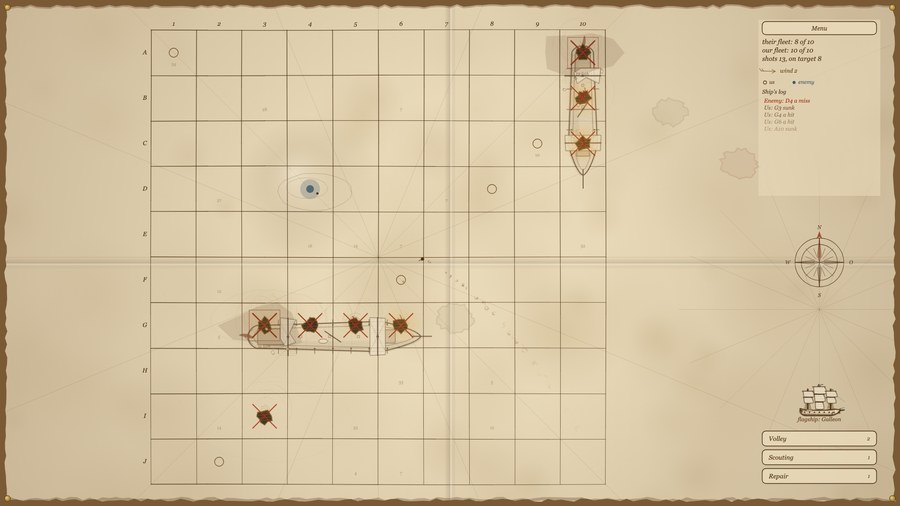
Battleship has an Online screen with three ways in: find a random opponent, invite a friend into your own room, or join a friend's room by code. The code is six characters, and the room shows only the code, so read it out in a message or over the phone. Both fleets are placed by lot on equal terms. If a random opponent does not show up, a bot takes the seat, and if the connection drops the game returns you to the same battle.
- Good for: long distance, odd hours, and pairs who would rather exchange a short code than a link.
- Not for: anyone who wants to place their own fleet in an online battle, because the fleets are dealt by lot, or anyone who wants to send a link instead of reading out a code.
Ten minutes: short rounds that still have a point
Classic tic tac toe on a 3 by 3 board takes about a minute, but with careful play it ends in a draw, and the master computer never loses. That is fine as a warm-up and dull as a main course. Two better short picks:
- Vanishing marks. Each side has at most three marks on the board, and the fourth erases the oldest. The game stays short, but every move now costs something. Good for a quick round; not for anyone who wants to plan ten moves ahead.
- Checkers puzzles. Eighty puzzles ask you to find the winning move, sometimes two or three in a row. Two people can take turns: one suggests, the other checks, hints are available. Good for five minutes without a match; not for anyone who needs a score and a winner.
A whole evening: rule sets worth learning
If you have an hour and want something less familiar than classic checkers, two options earn the time.
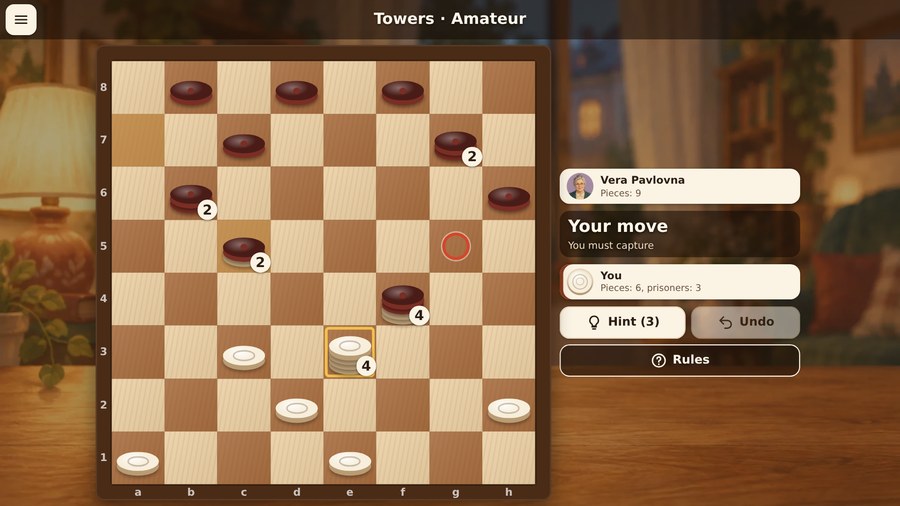
Towers. Old Russian column checkers. A captured piece does not leave the board: it goes under the piece that captured it, and towers are taken from the top one piece at a time, so a prisoner can end up on top again. A tower belongs to whoever has a piece on top. The board looks familiar, the decisions are not. Not for a pair with ten free minutes, because the first game is partly a lesson.
Nine Boards. A big board made of nine small ones: the cell you pick inside a small board sends your opponent to that small board, and three small boards in a row win the game. This is the deepest game in the tic tac toe set, and a round still fits in five to ten minutes. Not for a beginner on the first try, and not for small phone screens where the cells are tiny.
Giveaway checkers. The goal upside down: the first player to give away all their pieces, or to be left with no move, wins. It is the best answer we know to "you always win". Not for two beginners, because it is confusing before plain checkers make sense.
When one of you is new
Do not start with a match between the two of you. Checkers has a school of ten lessons that teaches the game from scratch, and tic tac toe has a practice game that explains the rules in a couple of minutes. Then play the computer at the beginner level: it makes mistakes, which gives a new player room to win something. Only after that sit down against each other.
How to invite a friend
- Open the game and pick the online game with a friend.
- The game creates a room and shows a code, a link and a QR code.
- Send the link, or let your friend point a camera at the screen.
- Your friend opens the link in their browser and takes a seat.
That is how checkers and tic tac toe work. Battleship has rooms too, but no link and no QR code: press Invite a friend, read the six-character code to your friend, and they press Join by code and type it in. A random opponent is the other option if you just want a game. Decide in advance who creates the room, because only that person sees the code.
More two-player options are collected in two player games and games to play with friends.
On a phone
- Small cells. In tic tac toe the first tap shows the mark and the second places it, so a slip of the finger does not cost a move. In checkers, tapping a piece and then a square is easier than dragging.
- QR codes. Phone to phone, a camera is awkward, so send the link in a message instead.
- The clock. Online tic tac toe gives you thirty seconds per move, and on a phone that feels shorter.
- Battleship. The easiest of the three on a phone: one tap, same controls as on a computer.
Honest downsides
- In an online battleship game both fleets are placed by lot, so there is no manual setup, and the room code has to be typed or read out, because there is no link.
- Checkers against a live person has no hints and no undo.
- Classic tic tac toe is a draw with correct play.
- Opponent matching can end with a bot in the seat instead of a person.
- Giveaway and Towers confuse people on the first game; they need a short walkthrough.
- Both players have to be at the screen at the same time, because a round runs in real time.
- Checkers has three optional one-time purchases: remove ads, all themes, unlimited hints. Tic tac toe has one, remove ads. There are no subscriptions and no automatic charges, and none of it changes the rules of a match.
Quick summary
| Situation | Try |
|---|---|
| Same room, familiar game | checkers on one screen |
| Different cities | checkers, tic tac toe or battleship with a room code |
| Ten minutes | vanishing marks |
| One player always wins | giveaway checkers |
| Something unfamiliar | Towers |
| A beginner | checkers school, tic tac toe practice game |
| Want battleship | Invite a friend in battleship |
| No match, just thinking | eighty checkers puzzles |
If you are choosing by mood and group size rather than for exactly two people, our general picks cover that; this article stays narrow on purpose.