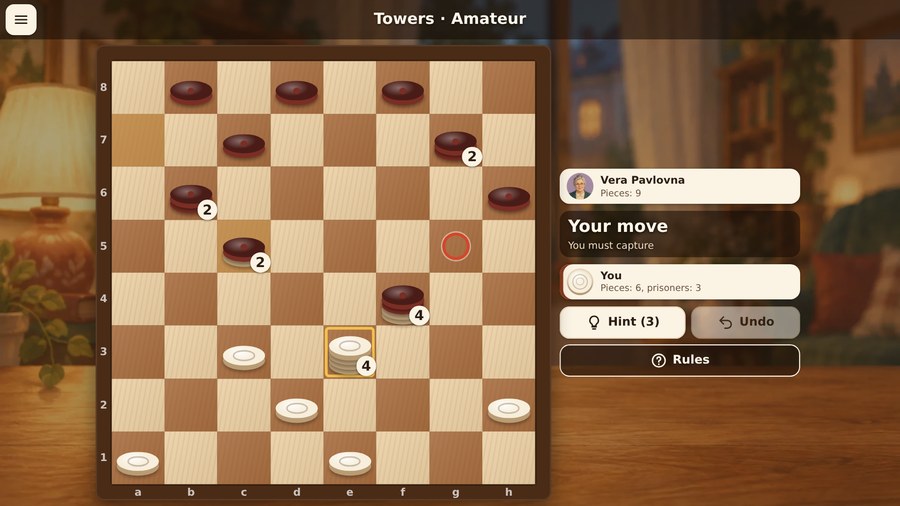
Checkers vs chess: differences and where to start
A practical comparison of the two 8x8 classics: pieces, captures, the goal, the learning curve, game length and depth. Plus two myths and a clear first step in each game.

Short answer: if you want to be playing tonight, pick checkers. If you want a long study with openings, endgames and a rating, pick chess. They do different jobs. Checkers gets you to a real game faster; chess gives you a longer road.
Both are 8x8 board games with tournaments, theory and champions. The difference is the entry threshold and how much time you want to give one game. This comparison avoids vague claims about brain training: those are hard to prove, and they do not help you choose.
The baseline here is Russian checkers, the default in our game. Other variants are covered in the checkers variants guide, from 8x8 to 12x12 boards and rules that change the game noticeably.
The comparison in one table
| What we compare | Checkers (Russian) | Chess |
|---|---|---|
| Board and pieces | 8x8, 12 pieces each, two kinds: man and king | 8x8, 16 pieces each, six kinds |
| How pieces move | A man one square diagonally, a king any distance | Every piece has its own move |
| Capturing | By jumping, compulsory | Different for each piece, never compulsory |
| Goal | Capture all pieces or leave the opponent with no move | Checkmate the king |
| Draws | Agreement, threefold repetition, 15 moves by each player with kings only and no captures | Stalemate, insufficient material, repetition, 50-move rule, agreement |
| Entry threshold | Rules visible from the first move | You need the moves of six pieces |
| Game length | Usually a few minutes | From a couple of minutes in blitz to hours in classical |
| Depth | Tactics, puzzles, endgames; less theory | Openings, middlegame, endgame; a lot of theory |
| Online | A friend room by code, link or QR, plus opponent search | Lichess and other sites |
Russian checkers is the baseline. International draughts is 10x10 with 20 pieces, Canadian is 12x12 with 30, and Wolf and Sheep and Corners have no captures at all.
Where checkers wins
You can play sooner. The rules fit in a few sentences: move one square diagonally, jump to capture (a man can also capture backward), reach the last row and become a king. You can start a real game a minute after someone explains it. Chess asks you to learn six different pieces first.
The rules are visible on the board. Nothing is hidden: every man moves the same way, and a king only differs in range. A beginner does not have to remember that pawns capture one way and move another, or that knights jump.
A game is short. Most checkers games take a few minutes, so half an hour gives you several games instead of one.
There is a ready learning path. Our game has eighty puzzles on finding the winning move and a school of ten lessons. Puzzles take a minute; the school starts from zero. After a game, the review marks the best move, inaccuracies and blunders.
Nine rule sets on one board. Russian, giveaway, Towers, English, Brazilian, international, Canadian, Wolf and Sheep, and Corners. If the classic gets stale, switch the rules and get a different game without learning a new interface. Giveaway flips the goal, Towers adds prisoners and columns, international makes the board bigger.
You can play a friend. Open a room and the game shows a code, a link and a QR code, or search for an opponent who plays your rules. Three computer levels let you start without pressure. One honest caveat: games against a live person have no hints and no undo.
Where chess wins
Depth. Chess has three clear stages: opening, middlegame and endgame. Each has its own theory, and almost any question has a worked-out answer. After a month you feel you have learned not just the rules but the language of the game.
A long improvement curve. A rating, game analysis, new ideas. Progress is not instant, but it can be measured. For many players that is the main attraction.
An international scene. Tournaments, ratings, federations and broadcasts. Chess is known far beyond its clubs, and finding an opponent at any level is easy.
Lichess for a first step. A free site funded by donations, with no ads. It has games against people and computers, puzzles, lessons and analysis. That is enough for the first months, and paying is optional.
Different time controls. Blitz takes a couple of minutes, rapid around ten, classical can run for hours. Checkers games are usually shorter, so the spread is smaller.
Myth one: checkers is primitive
Simple rules do not mean a simple game. Russian checkers has compulsory captures, a king that flies along diagonals, and jump chains that can end somewhere unexpected. That is enough to make a game tactical, especially in giveaway, where you have to force your opponent to capture.
Checkers also comes in very different forms. Towers is column checkers, where a captured piece does not leave the board but goes prisoner under the winner. International draughts is played on 10x10 and demands the longest capture. Canadian goes to 12x12. Calling all of that primitive is easy only before your first game in an unfamiliar rule set.
Myth two: chess is only for geniuses
The basic rules take an evening. You need the moves of six pieces, check, checkmate, castling and pawn promotion. That is enough for a first game with a friend or a low-level computer.
Openings, ratings and theory come later. Nobody has to learn them before the first game. Start with a few games and a look at your mistakes, then pick one opening for White and one for Black. Genius is not required; playing and reviewing is.
How to start
If you chose checkers
- Read the checkers rules: setup, compulsory captures, the king, draws.
- Play a few games against the computer at the beginner level.
- Solve ten puzzles. They are short and show where you lose a move.
- Take the ten-lesson school if you want a system.
- Invite a friend to a room or play two on one screen.
- Look at the checkers variants when the classic becomes familiar.
If you chose chess
- Learn how the pieces move, castling, en passant and pawn promotion.
- Play a few games against a low-level computer without chasing a result.
- Create a Lichess account and work through the beginner lessons and puzzles.
- Review your games: one reviewed game teaches more than five played in a row.
- When the rules stop taking all your attention, choose one opening for White and one for Black.
Common questions
Is checkers easier for a child? Yes. It has fewer piece types, a clear goal and shorter games. Chess works for children too, but start with a few pieces rather than the whole board.
Can two people play on one board? Yes, both games use an 8x8 board. Our checkers has a two-player mode on one screen, and you can open a room for a friend online.
How long does a game take? A checkers game usually takes a few minutes. A chess game depends on the time control: blitz can be over in a couple of minutes, classical can take hours.
Are there draws? Yes, in both. In checkers a draw comes from agreement, threefold repetition, or 15 moves by each player with only kings and no captures. In chess a draw comes from stalemate, insufficient material, repetition, the 50-move rule or agreement.
Which is better for playing online with a friend? If you want to invite a specific person with a link or a code, checkers takes a couple of taps. In chess, Lichess lets you create a game and send your friend the link.
Can I learn on my own? Yes. Checkers has the school and puzzles, chess has lessons and puzzles on Lichess. The main thing is to play regularly and review at least some of your games.
The short version
Checkers and chess do not replace each other. Checkers is a quick start, a short game and many rule sets. Chess is a long road, a lot of theory and an international scene. Start with the one you have time for today, and try the other in a month. If you need someone to play with, look through our two player games.