What is a browser RPG and how it differs from an MMORPG
Three terms get mixed up all the time: RPG, MMORPG and browser RPG. Here is the short version, the signs that tell them apart, and an honest answer about our own game.

Short answer: an RPG is a genre where you play a role and develop a character. An MMORPG is the same kind of game in one shared world for many players at once, and that world keeps running when you log off. A browser RPG opens in a browser tab and can be single player, a small online game, or a genuinely massive one.
The three words answer three different questions: what kind of game it is, how many people share the world, and how you launch it.
What an RPG is
A role-playing game gives you a character to build and decisions to make: stats, gear, skills and a story that reacts to what you do. You are not just clearing levels, you are shaping a character around your own style, whether that is a fighter, a mage or a craftsperson.
Not every game with levels is an RPG: a shooter unlocks ranks and weapons, but the role and the story do not change with your choices. And not every RPG is fantasy with swords: there are detective, space and historical role-playing games.
Classic RPGs are usually single player: story branches wait until you reach them, and the world stops at the ending.
What an MMORPG is
MMORPG stands for massively multiplayer online role-playing game. The key word is massively: one shared world is open to a large number of people, all playing at the same time on the same land.
Four signs identify an MMORPG without any label.
- A persistent world. It runs while you sleep, work or stay away for a week, and other players build, trade and claim things.
- Many people in one place. In a town square, at a dungeon entrance or on a market you meet strangers, not only friends from your list.
- Social systems. Chat, parties, guilds, raids, trade and reputation make playing together possible, not decoration.
- Long progress with no ending. An MMORPG usually has no final credits: after the last raid comes the next season.
Large MMORPGs usually ask you to install a client, as World of Warcraft and Final Fantasy XIV do. EVE Online and Albion Online are known for player-driven economies. Different games, same signs: one world, a crowd and years of progression.
How an MMORPG differs from a single-player RPG
The table below is about structure, not about specific games.
| Sign | Single-player RPG | MMORPG |
|---|---|---|
| Players in one world | one, sometimes co-op for two or a small group | many, from hundreds to thousands per server |
| What happens while you are away | the world waits | the world keeps changing |
| Whose story it is | your hero's | the community's, with a personal thread for each player |
| Social systems | an invite for a friend at most | chat, parties, guilds, market, reputation |
| Economy | merchant-driven | largely player-driven |
| When it ends | there is an ending | usually no ending |
| Time needed | a few evenings to finish | regular visits over months |
The main difference is where the centre of the game sits. In a single-player RPG the world is tuned to your pace. In an MMORPG you are one of many: the world will not wait, and some activities are built for a group.
What a browser RPG is
A browser RPG is a way to launch a game, not a separate genre: it opens from a link in a tab, nothing to install. Very different games live under that name.
- A single-player text RPG. Story, choices and progression with little or no graphics.
- A small online RPG. A world for dozens or hundreds of players, where you play with friends rather than strangers.
- A real MMORPG in a tab. A large world, a market and groups, just without a client.
So not every online game is an MMORPG. Online checkers or a shooter with matchmaking are online too, but there is no world: there is a room for one match. And not every browser RPG is massive: many are built for a small circle, and that is fine.
To tell what you are looking at, ask four questions.
- Do you meet strangers in a shared world, or only friends you invited?
- Does the world continue while you are away?
- Is there trade between players and shared activity such as guilds or parties?
- How many people are on one server: dozens, hundreds or thousands?
If the answers are yes and thousands, it is probably an MMORPG. If the world is small but shared and persistent, it is a small online RPG. If there is no world at all, it is a single-player or session game.
Free Lands: a small online RPG, not a huge MMO
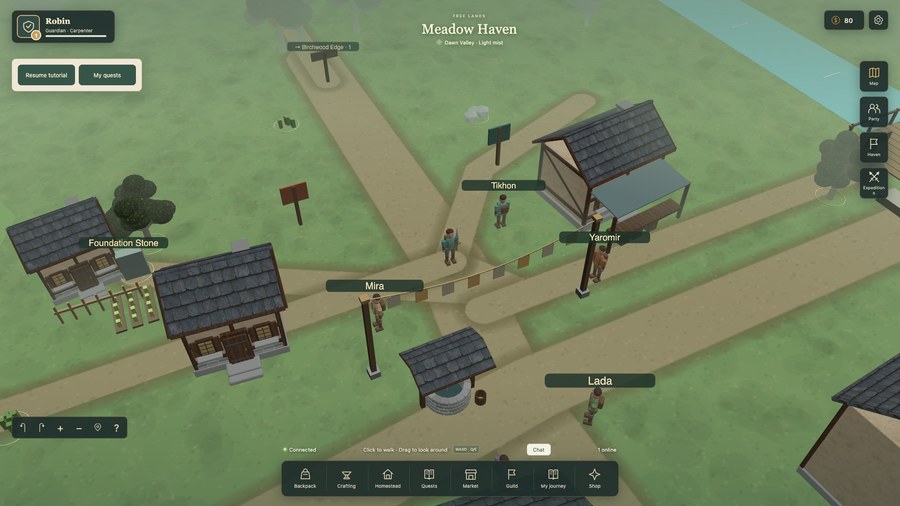
Our game Free Lands is a browser online RPG: free, nothing to install, play with friends or alone with companions. One honest warning: it does not have the scale of a large MMO.
What the game has:
- the small settlement of Meadow Haven, twelve regions and almost a hundred places on the atlas;
- a combat role and a profession, a house, furniture, plants and animals;
- crafting: gear and goods for the settlement are made from materials you gather;
- journeys with turn-based fights, rests and bosses, alone with companions or with a party of friends;
- a shared campfire chat (land, party, guild and private talks) and a market where players list goods;
- progress on the server: your hero, items, house and quests survive clearing the browser, and a recovery key moves the hero to another device.
What it does not have: thousands of players on one map, huge raids, and a world economy that runs by itself. It is a small online RPG where you go on a journey with friends or companions instead of disappearing into a crowd.
Why that is a normal choice. A large MMORPG demands time and a group: seeing the content means matching other people's schedules. A small game forgives a short evening and gives you a clear goal for a couple of hours. If you want a crowd on a shared map, this is not the game for you. If you want a calm online world with friends and a house that will not vanish, Free Lands fits.
How to choose a game
Compare your habits, not genres. The table works for any game, not only ours.
| What matters | What to check |
|---|---|
| Scale | how many players per server, and whether you want strangers around |
| Time | can you play for twenty or thirty minutes without losing progress |
| Social side | parties, chat and shared activity, or a single-player game |
| Payments | cosmetic and convenience items, or power and faster progression |
| Platform | does it open in a browser on a phone and a weak laptop |
| Progress | where the hero is stored and what happens if you clear the browser |
If a game matches your answers, the genre label matters little. If it does not, a big word on the cover will not help.
FAQ
What is an MMORPG in simple terms? An online role-playing game where one shared world is open to many people, and it keeps running after you log out.
How is an MMORPG different from an RPG? By the number of players in one world, the persistence of that world, social systems, a player-driven economy and the absence of an ending.
Can you play an MMORPG in a browser? Yes, though fewer than among client games. A browser version is usually simpler and aimed at weaker devices.
Is Free Lands an MMORPG? It is a small online RPG, not a massive one. It has a shared world and other players, but not thousands of people on one map.
Do I need to install anything? No. The game opens in a browser on a phone, tablet or computer.
Where is progress stored? On the game server. Your hero, items, house and quests survive clearing the browser, and a recovery key lets you continue on another device.
The short version
RPG answers what you play, MMORPG answers with whom and in what kind of world, and browser RPG answers how you launch it.
To see what browser MMOs and online RPGs exist at all, start with our collection of browser MMORPGs. For a small online RPG with a house and journeys, open Free Lands: a couple of minutes will show whether this scale suits you.