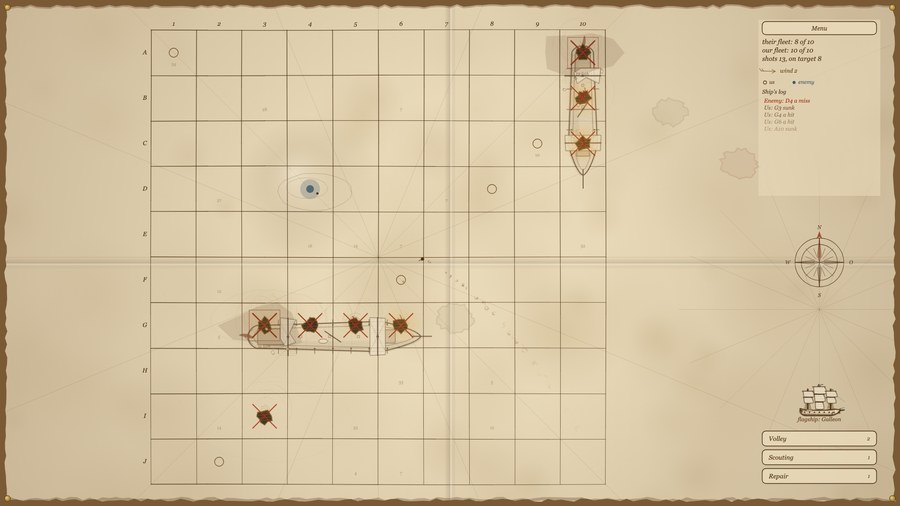
Battleship rules and ship setup
The grid, the five ships, how to place them, how a turn works and how to win. Then what changes in the Russian version with ten ships, which is the one in our game.
Short version: each player has a 10x10 grid and a secret fleet of five ships, lengths 5, 4, 3, 3 and 2. You place them in straight lines, horizontally or vertically, without overlapping. Then you take turns calling a square on the other player's grid, and the opponent answers "hit" or "miss". When every square of a ship has been hit, it is sunk. The first player to sink all five enemy ships wins.
That is the version sold as a boxed board game. The paper-and-pencil game played in Russia and nearby countries has a different fleet of ten ships and stricter placement. Our online Battleship uses that classic Russian set, so this page explains both. Nothing to install: it opens in the browser.
The grid
The standard grid is 10 columns by 10 rows, 100 squares. Columns are letters A to J, rows are numbers 1 to 10. A square is a letter and a number, such as B7 or J10. Each player has two grids: one for their own ships, and one for tracking shots at the opponent. On paper they sit side by side. In the boxed game one is a flat board and the other stands upright, hidden from the opponent.
How many ships, and how long
The boxed game has five ships, 17 squares in total.
| Ship | Squares |
|---|---|
| Carrier | 5 |
| Battleship | 4 |
| Cruiser | 3 |
| Submarine | 3 |
| Destroyer | 2 |
So the answer to "how many ships are in Battleship" is five, and the answer to "how many squares do they cover" is 17 out of 100. Names and sometimes the lengths vary a little between printings, and the paper game often uses other sets, so agree on the fleet before you start.
How to place your ships
- Every ship lies in a straight line, horizontally or vertically. No diagonals, no bends.
- A ship must fit entirely inside the grid. Edges and corners are fine.
- Ships cannot overlap. In the standard rules they are allowed to sit side by side, though some players add a house rule that ships may not touch.
Once the first shot is fired, ships stay where they are.
How a turn works
- Decide who goes first, by agreement or a coin toss.
- On your turn, call one square, for example "E5".
- Your opponent checks their grid and says "hit" or "miss". If the shot completes a ship, they also say which one: "you sunk my battleship".
- You mark the result on your tracking grid, usually a red peg or cross for a hit and a white peg or dot for a miss.
- The turn passes to your opponent.
In the boxed game you fire one shot per turn, hit or not. That is the biggest practical difference from the Russian version, where a hit earns you another shot.
How the game ends
A ship is sunk when every one of its squares has been hit. The game ends the moment one player has lost all five ships. The other player wins. There are no draws.
Common questions
Can ships touch? In the standard boxed rules, yes: nothing forbids ships lying next to each other, even in a solid block. Many players ban it by house rule to make ships harder to find. In the Russian version a gap of one empty square, diagonals included, is mandatory.
Can ships go along the edge? Yes.
Does a hit give you another turn? Not in the boxed game. Yes in the Russian version.
Can I move a ship during the game? No.
What if I call the same square twice? It wastes your turn. Keep your tracking grid up to date.
Do I have to tell the opponent which ship I hit? In the boxed game you only announce a sinking and the ship's name. Any other information is a hit or a miss.
Variants
- Salvo. You fire as many shots per turn as you have ships left, then the opponent answers all of them at once. Losing ships reduces your firepower.
- Extra shot after a hit. The Russian rule. It makes streaks of luck matter more.
- Smaller or larger grids. A 7x7 or 8x8 grid with a shorter fleet makes a quick game for children.
- Ships may not touch. The popular house rule, and standard in the Russian game.
The Russian version in our game
The classic Russian Battleship, "Morskoy Boy", plays on a 10x10 grid too, but the fleet is ten ships: one of four squares, two of three, three of two and four of one. That is 20 squares in total. Columns use the Russian alphabet from А to К, skipping the letter Й, which gives exactly ten. Ships must not touch each other, not even at the corners. A hit gives you another shot until you miss.
Our Battleship game follows those rules. You can pick a grid of 8, 10 or 12 squares. On 10 the fleet is exactly the ten ships above. On 8 it is six ships, on 12 it is thirteen, including one of five squares. You can place the fleet yourself, rotating a ship with the R key or a right click, or have it placed with one button. Play against a bot at three levels, against a live opponent online, or in a five-battle campaign. It is free.
Our game does not offer the five-ship fleet, only the Russian one, so if you want the boxed set, play it on a physical board.