
Where Durak came from
Durak is so familiar in Russia that it feels like it has always been there. In fact the game is younger than many people think, and its history is known only in fragments.
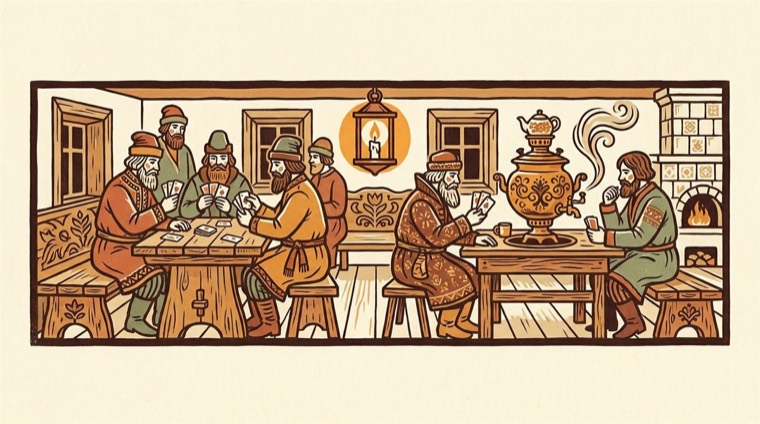
When the game appeared
It is hard to speak with confidence about the origins of Durak: card games lived in oral tradition for a long time and barely made it into written sources. Descriptions of games from this family in Russia date to the nineteenth century, and Durak became a mass game only in the twentieth.
The game has relatives outside Russia too. Similar mechanics, where you fend off the opponent's cards instead of collecting tricks, turn up in various countries of Eastern Europe.
Why 36 cards
The 36-card deck is a shortened French deck: the twos, threes, fours and fives were removed from the full one. Such a deck was cheaper and handier for games where speed matters more than a long ladder of ranks.
For Durak the size turned out just right. With six cards in hand and two players, the deck runs out after about five or six rounds, and the game does not have time to get boring.
Where the name comes from
The name speaks for itself: durak means "fool" in Russian, and the loser is left the fool. It is a rare case of a game named not after an action or a prize but after the loser. In most games the goal is "get more"; here the goal is not to be the last one.
That gives the game its special mood. Durak has no winner in the strict sense: players drop out one by one, and all the drama goes to the last one.
Why the game survived
Durak combines three useful qualities. The rules take a minute to explain. A game lasts a few minutes and is easy to interrupt. And there is still room for calculation, so a beginner and an experienced player will play it differently.
Plus the deck. Thirty-six cards fit in a pocket, and you could play anywhere: on a train, in the yard, in the kitchen. No board or pieces needed.
The most common variants
- Throw-in (podkidnoy). The classic, the one people usually mean.
- Passing (perevodnoy). Lets you pass the attack on if you have a card of the same rank.
- With epaulettes (pogony). As a joke, cards are placed on the loser's shoulders; the rule is purely a ritual.
- House variations. There are dozens of them, and every group has its own tweaks.
That is why, before playing with people you do not know, it is customary to check the rules: they almost certainly have something of their own.
Play the classic
The rules in the game are the same as a hundred years ago: 36 cards, the trump under the deck, "done" and "take".